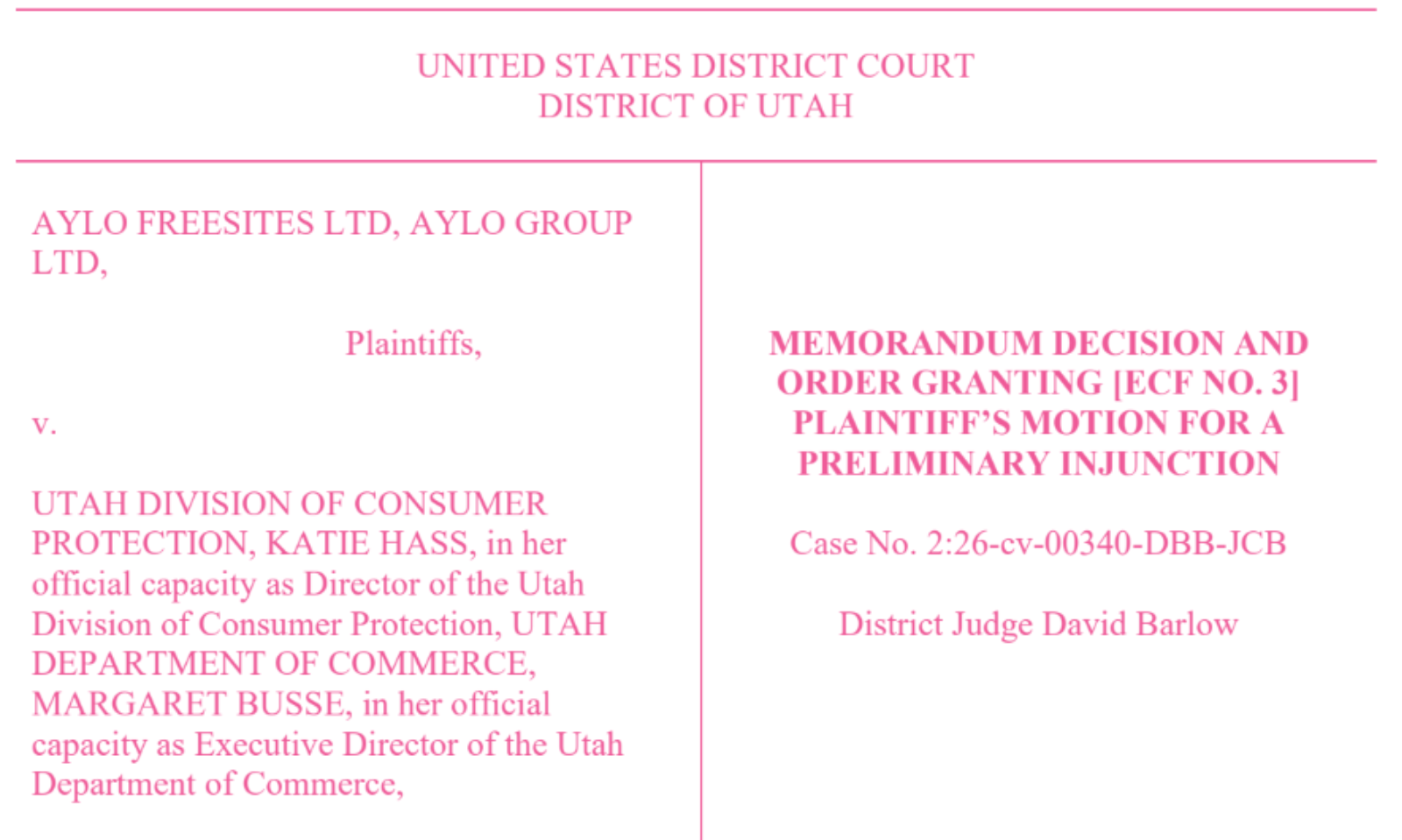
SALT LAKE CITY—A federal judge in Utah this week granted a preliminary injunction to Aylo, the parent company of adult tube website Pornhub.com, blocking the enforcement of Senate Bill (SB) 73.
SB 73 is a recent law that blocks the use of a virtual private network (VPN) to circumvent the state's age verification statute.
Two of Aylo's affiliated companies filed suit in late April of this year against Utah's Division of Consumer Protection and its Department of Commerce, which resulted in a mutually agreed-upon delay in enforcing the statute of 120 days initially.
The delay was extended into October under a mutual agreement submitted to the court at the end of August. Now, the VPN provisions are enjoined and temporarily blocked from being enforced as litigation plays out.
"We are pleased with the Court’s ruling and appreciate its careful consideration of the issues," a spokesperson for Aylo told AVN. "We remain committed to complying with applicable law while safeguarding user privacy and security."
Aylo’s spokesperson added, "Although Aylo believes that Utah’s age-verification law is not sufficiently protective of users’ privacy, that law is not at issue in this case. To be clear, age verification is a good thing, if done correctly. We firmly believe age verification can make the internet a safer space for everyone, when it is done right."
"We have long worked with governments around the world to better protect kids online," Aylo added. "Age verification legislation in other jurisdictions is failing for a number of reasons, including its inconsistent and ineffective enforcement at scale, leaving hundreds of thousands of platforms with age inappropriate content accessible, most of which do not have content moderation or uploader verification measures."
U.S. District Judge David Barlow of the District of Utah found that "[the] harm of a constitutional violation is greater than Utah's interest in enforcing a statutory provision that likely is unconstitutional."
SB 73 requires adult websites to verify the age of a user who is "actually located" in Utah, regardless of the use of proxy tech, including virtual private networks and proxy servers used to spoof IP addresses.
"Because Aylo has shown a substantial likelihood of a constitutional violation and irreparable harm from that violation, 'it follows that the balance of equities and the public interest' are in its favor," explained Barlow, an appointee of President Donald Trump. The district judge also found that requiring the lifting of a "masking" technology to reveal a user's "actual location" likely violates the dormant Commerce Clause, meaning that Utah's restriction on interstate commerce violates the U.S. Constitution.
"The court finds this harm sufficient and does not consider whether Aylo’s other alleged harms are irreparable," Barlow noted.
He concluded, "Aylo argues that because it is impossible to always determine where a user is actually located, Utah’s actual-location provision will require it to age-verify all users, wherever they might actually be located, or face liability. As a result, the actual-location provision operates as an impermissible direct regulation of wholly out-of-state conduct."
This is noteworthy, as the judge interpreted that Utah can only enforce elements of web traffic that can be proven to be from Utah. And as the provider of software like a VPN is inherently extraterritorial, a state-level provision blocking VPN usage faces constitutional hurdles.
Corey Silverstein, an attorney representing adult industry clients, told AVN that he observes this ruling as a step in the right direction.
"The VPN provision placed an impossible burden on adult websites by effectively requiring them to determine the true physical location of users who may be utilizing technology specifically designed to conceal that information," Silverstein observed. "The practical consequence was potentially forcing websites to apply Utah’s requirements to users across the country and around the world."
He added, "I applaud Aylo for committing the resources necessary to challenge this provision and for continuing to fight laws that raise serious constitutional and practical concerns for the adult industry."
Fuente: avn.com