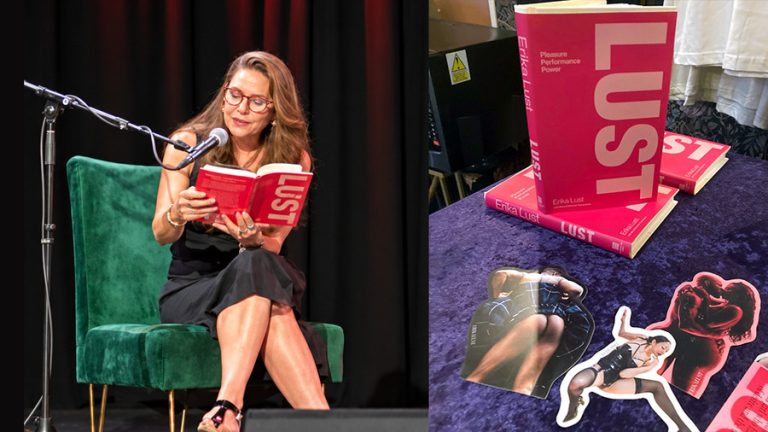
Erika Lust launched her memoir, "Lust: Pleasure, Performance, Power," discussing ethical pornography, sexuality, and societal reflections in LA. The event featured a Q&A with Gigi Fong.
Erika Lust, director, writer, and producer, launched her new memoir, “Lust: Pleasure, Performance, Power,” in Los Angeles on October 21, 2026. The event featured a discussion with Lust and journalist Gigi Fong, followed by a book signing.
The Los Angeles launch event for Erika Lust’s memoir, “Lust: Pleasure, Performance, Power,” took place on Tuesday night at the Dynasty Typewriter inside the Hayworth Theatre. The event was presented by Los Feliz bookseller Skylight Books.
Lust’s memoir, published by Metropolitan Books, chronicles her journey as a feminist pornographer. The book advocates for ethical pornography and explores how adult media influences lives, arguing for an ethical industry that can change perceptions of sexuality, power, and representation. Lust has been creating adult content for over 20 years, with the aim of expanding the parameters of pornography and approaching it with a cinematic vision.
The event began with a question-and-answer session featuring Lust and Gigi Fong, a staff writer at VICE who specializes in sex and wellness. During their discussion, Lust addressed various topics, including the complexities women encounter regarding sexuality, such as reconciling feminism with submissiveness. She emphasized the detailed pre-conversations and clear boundaries established in performer contracts for her films. Lust suggested that understanding these processes could inform how individuals negotiate sexual relationships in their private lives.
Lust discussed her belief that pornography reflects societal issues rather than being their cause. She stated that the industry is frequently made a scapegoat for social problems, which she believes diverts attention from effective communication and addressing serious issues. Lust suggested that pornography could facilitate communication, noting that it represents performance and fantasy that can help people communicate, especially regarding sex and needs.
Lust also addressed what she perceives as a new wave of anti-sex sentiment, amplified by technology, contributing to negative feelings about sex in general. She contrasted the current environment with that of 2000, before the widespread use of social media and camera phones, describing today’s world as one of surveillance where individuals police themselves due to constant observation.
The author recounted her first gangbang scene with Kazumi, an experience she described as life-changing. This experience, detailed at the beginning of her book, widened her view of sexuality and strengthened her belief in her vision of herself and her art. She explained that this personal exploration helped her minimize the impact of negative external opinions and define her own limits. Lust acknowledged that she has been both praised as an industry pioneer and dismissed as irresponsible, but stated that her self-perception and the work she and her crew produce are what matter to her now.
Lust discussed the impact of her personal growth on her family relationships. She contrasted her regret about not connecting more fully with her mother with her sense of accomplishment in her connection with her own children. She spoke about raising her 19-year-old son, who came out as trans at 15, expressing pride in creating a safe space for him to live his life. However, Lust also admitted to ongoing personal conflicts, such as her belief in a woman’s right to dress as she chooses versus her parental worry about her 16-year-old daughter’s school outfit choices.
Empathy, Lust stated, is instrumental in her decision-making, both personally and professionally, even when choices are not immediately profitable. She provided examples of video removal requests she honored: one from a performer who had transitioned and another from a divorced performer couple. In both cases, the requests stemmed from emotional pain over public representations that no longer reflected their current identities, a feeling Lust understood and prompted her to honor the requests.
Lust also highlighted the importance of communication in collaborations, citing her work on the book with journalist Mary Katharine Tramontana. They met when Tramontana wrote a 2002 New York Times profile on Lust and have since developed a working relationship. Lust explained that as a Swedish speaker with English as a second language, she needed someone who could address complex questions and cultural conversations surrounding feminism and pornography, which she believes are not being discussed appropriately. This was a motivation for writing the book.
The original subtitle of “Lust” was “Porn, Performance, Power,” but Lust was urged to change it for marketability. She likened this to Mick Jagger being compelled to change lyrics for a television appearance. Lust stated that while "Porn" was removed from the cover, it remains within the book’s pages.
Lust also discussed the challenge of confronting uncomfortable aspects of her personality during the writing process, including her own contradictions, such as being a pornographer while still experiencing pornophobia. She described the process as ultimately gratifying, finding reward in meeting readers and hearing how the book has helped them identify with its stories and gain a deeper understanding of their own sexuality.
Following her solo reading, Lust was joined on stage by Gigi Fong for a discussion, after which Fong moderated a Q&A session with the audience. Notables such as Casey Calvrt, Bree Mills, and Nina Hartley posed questions. Lust concluded the evening with an hour-long book-signing session.
9,673,630 page views
Fuente: adultfyi.com